Donation Deferral
Never Let Me GoDonation Deferral is the rumored chance for a Hailsham couple to postpone their donations for several years by demonstrating that their love is genuine. It gives students a possible reprieve from a future they have only partly understood, but the hope rests on rumor rather than policy: Miss Emily eventually explains that Hailsham could never grant such a postponement, even when its influence was at its height.
The Rumor and Its Terms
The story Chrissie recounts offers a specific condition and a seemingly concrete reward. She says that Hailsham students in exceptional circumstances could ask to have their donations delayed by three or even four years. The supposed test was that a young man and woman had to be genuinely in love and able to show it. If the people responsible for Hailsham accepted their case, the couple could spend several years together before beginning their donations.
The rumor becomes vivid through its account of a particular couple. According to the story, a young man with only weeks before becoming a carer and his partner had their donations put back by three years. They were said to have been allowed to remain together at the White Mansion, without continuing their training. The named place, the length of the delay, and the claimed exemption from training make the story sound less like a vague wish and more like an established precedent. Yet Chrissie presents it as something heard from others, not as a rule she has verified.
The account matters because it makes postponement seem conditional rather than impossible. Love, if it could be proven, might earn time outside the ordinary sequence of training and donation. The promised years are not described as an end to the Donation Programme, but as an interval in which a couple could live together before it began for them.
How the Hope Circulates
Chrissie and Rodney bring the question to the Hailsham students after hearing stories in Wales. At the Cottages, they cannot discuss the subject freely, and Chrissie says that people are always listening. Kathy H. recognizes that this expedition has, for them, a purpose beyond visiting and socializing: they want to find out whether the Hailsham students know how a deferral might be obtained. Their cautious approach makes the rumor’s social function visible. They are not merely repeating an entertaining story; they are testing whether others can confirm a possibility on which they may be emotionally relying.
The rumor is already circulating among veterans at the Cottages. They tend to fall silent when others approach, so information reaches Kathy H. in fragments. She has heard enough to understand that the supposed opportunity is associated particularly with Hailsham, but the café conversation reveals how much weight some veterans have placed on it. When Ruth nods as though she recognizes Chrissie’s account, Chrissie and Rodney watch her intently. Her apparent authority strengthens their hope, even though she has not established that the story is true.
Tommy challenges the assumption that the idea came from Hailsham. He tells Kathy H. that he remembers no discussion of lovers receiving extra time there, and suggests that people such as Ruth have helped sustain the belief among the veterans. At the same time, he does not simply dismiss the rumor. He considers whether it might explain things the students had found puzzling, showing how an uncertain story can acquire plausibility when it appears to answer earlier questions.
Tommy’s Explanation of the Gallery
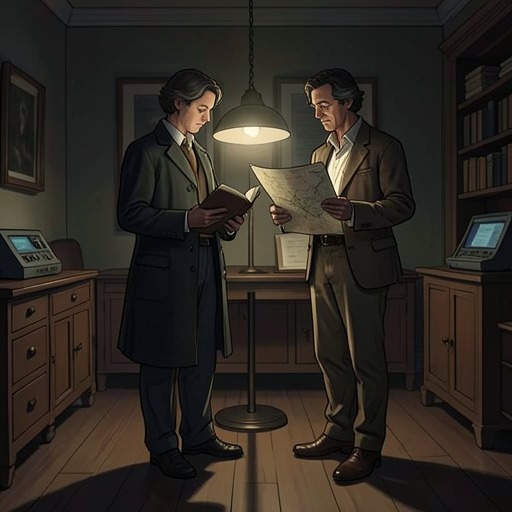
Tommy develops a theory about how a deferral might be decided. If a couple had to prove that their love was real, he reasons, the people making the decision would need evidence by which to judge them. He speculates that Madame might use the students’ art, collected over many years, to assess whether a couple’s work revealed a meaningful match. In his account, the gallery would serve as a record of the students’ inner lives and thus as a possible means of distinguishing deep attachment from a passing infatuation.
This interpretation links the rumor to Hailsham’s established culture of artistic exchange. Students made paintings, drawings, and pottery for the Exchanges held four times a year, receiving tokens for work that they could then spend on other students’ creations. Artistic ability affected status and esteem, while the objects students acquired became personal possessions. As the students grew older, the honor of having work selected by Madame came into tension with the sense that they were losing their most marketable creations. The practice of collecting student art therefore already carried both personal and institutional significance, making Tommy’s proposed explanation feel persuasive without making it true.
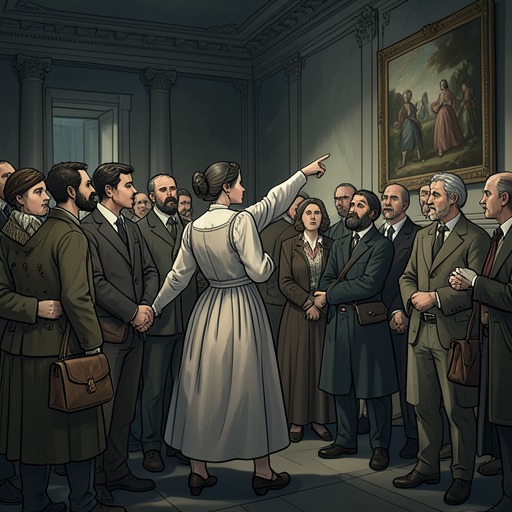
Kathy H. recognizes that his idea could account for some of what the guardians had said about creativity and for the removal of students’ work. But Tommy’s theory remains a hypothesis built on the rumor. Miss Emily later explains that the art was collected and displayed to demonstrate the students’ humanity to the wider public. During the movement’s most influential period in the late 1970s, Hailsham, Glenmorgan House, and the Saunders Trust used exhibitions to challenge the way the Donation Programme was run. The artwork was evidence in a public campaign for humane treatment, not a private test for deciding which couples deserved postponement.
The Claim and Its Consequences
When Kathy H. and Tommy eventually ask about a deferral, Miss Emily tells them that the hoped-for arrangement was never within Hailsham’s power to grant, even at the height of its influence. Her explanation closes the gap between the students’ interpretation of the gallery and its actual purpose. Hailsham had been able to provide cultivated surroundings and to argue publicly that its students were sensitive and intelligent; it had not secured the authority to delay their donations for couples in love.
The rumor nevertheless gains emotional force from the students’ incomplete knowledge of their future. The same uncertainty appears in the way donors approach a fourth donation. Tommy observes that people worry about it partly because they are not told for certain whether they will complete. Talk circulates about what might follow, including the frightening possibility of further donations without carers or recovery centres, but Kathy H. dismisses the subject rather than discussing it with him. This episode does not confirm those fears; it shows how a lack of reliable answers creates room for speculation, just as the lack of a real deferral rule allows hope to gather around stories passed from one group to another.
Kathy H.’s later care for Ruth gives this hope a personal context. After the relationship between the two women has become strained, talk of a stranded boat gives them something to discuss and helps make a shared trip possible. During that trip, Ruth gives Tommy a paper bearing Madame’s address and tells him that he and Kathy H. should at least try. The gesture shows that she has come to regard the possibility of a deferral as worth pursuing for them, even though the rule itself is unconfirmed. After Ruth’s second donation, Kathy H. promises her that she will become Tommy’s carer. These acts of care and attempted repair are real; the postponement they might have enabled is not.
Significance
Donation Deferral turns the students’ desire for time together into a story that seems to have rules, precedents, and an authority capable of granting it. Its circulation reveals how people in an information-poor system draw on fragments, apparent confidences, and interpretations of familiar practices to imagine an exception. The Hailsham art collection is especially vulnerable to reinterpretation because students know that their work is selected and removed but do not know the full public purpose behind that practice.
The eventual correction does not make the hope trivial. The rumor briefly gives the characters a reason to ask questions and to imagine that love might change the timetable imposed on them. But Miss Emily’s account distinguishes an achievement Hailsham did secure—the recognition of the students’ humanity—from the exemption it could not secure. Donation Deferral is therefore not a granted status in the novel; it is a persuasive, circulating possibility whose failure exposes the limits of both the students’ knowledge and Hailsham’s power.